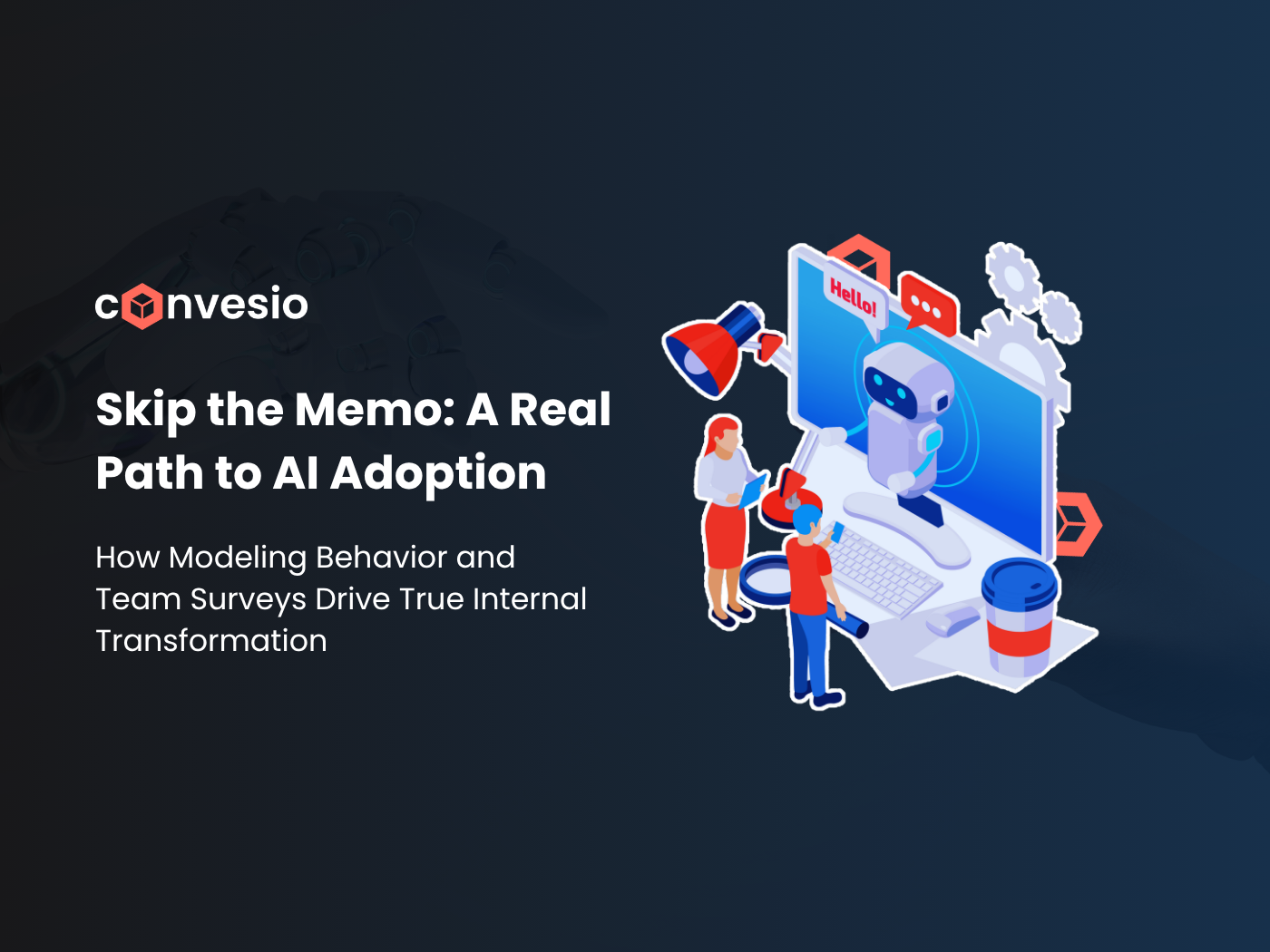
The fastest path to AI adoption isn’t a memo. It’s modeling the behavior
By Daryl Griffin, CMO, Convesio
There’s a familiar pattern when a company decides to “go all-in on AI.” A leader sends a memo. They name a few tools, link to a few prompts, and ask the team to start using them. A month later, adoption is uneven, the people who already loved AI love it more, and everyone else nods politely while continuing to do things the way they always did.
I wanted to skip that.
At Convesio, our work is technical excellence at scale, building a commerce platform that mid-market and enterprise operators bet their revenue on. We can’t get to where we want to be on AI by handing out memos. We have to start by knowing exactly where every person on the team is right now, and then build the training, time, and tools to bring everyone forward together.
That meant a survey first. Four questions. Have you used AI? Which models? What for? On a scale of 1 to 10, how comfortable are you?
Simple enough to write on a napkin. The interesting part wasn’t the questions. It was how I rolled it out and what that process taught me about how AI adoption actually works.
## Start where they are, not where you wish they were
Most AI adoption efforts fail in the same place. They assume everyone is starting from the same line. They aren’t. On any team you’ll find people running multi-step agentic workflows, people using ChatGPT for the occasional email, and people who haven’t typed a prompt in their life. If you build training for the first group, the third group tunes out. If you build it for the third group, the first group disengages and your strongest practitioners stop pushing the frontier.
You can’t fix that without data. So before any training, before any tool selection, before any “AI strategy” deck, I needed a real baseline of where Convesio actually is. The survey was the simplest possible way to get it.
What I didn’t want to do was spend half a day setting it up. That would have been the wrong message that AI adoption is something the leader does manually, while the team waits for instructions. So I used the tools I’m asking my team to use. The rollout itself became the demonstration.
## What actually happened
I asked Claude to plan it.
The conversation was short. I told it what I wanted: a ClickUp form-style task assigned to every employee with a Convesio email, a one-week deadline, an intro that made participation feel like an opportunity instead of a compliance checkbox, and a way to track who hadn’t completed it.
Claude handled the planning the way I’d want a good chief of staff to handle it. It asked the right questions, should the survey live as a single shared form or individual tasks per person, what was the scope of “employee,” what reminder cadence I wanted. Once I’d answered, it pulled the full workspace member list, filtered out partners, vendors, and anyone without a convesio.com address, and surfaced over 50 employees for me to review and approve.
Then it created the tasks. All of them, in parallel, in under a minute. Each one assigned, due-dated, with the same intro and instructions. It scheduled an automated reminder to fire one day before the deadline that pings only the people who haven’t completed yet so the laggers get a nudge while the early finishers don’t get a duplicate notification.
Here’s the honest part. Claude couldn’t do everything from inside our chat. ClickUp’s API doesn’t let outside tools create new custom fields or build new dashboards, those capabilities sit inside ClickUp’s own AI. So twice, I had to leave Claude and go work directly inside ClickUp.
Both times, Claude wrote the prompt for me.
## The interesting part is the handoff
That’s the part of this story I keep thinking about.
When Claude hit the wall on custom fields, it didn’t just stop. It wrote a clean, specific instruction for ClickUp’s AI to follow “Create these four custom fields on the AI Adoption list. Field one: dropdown, options Yes / No. Field two: multi-select labels, options ChatGPT, Claude, Gemini, Copilot, Perplexity, Grok, Other…” I pasted it into ClickUp. ClickUp’s AI built the fields. We moved on.
Same thing with the dashboard. Claude wrote a paragraph-long brief describing the seven widgets I wanted, a completion donut, a comfort histogram, a model usage breakdown, an outstanding tasks list, a recent submissions view and how to lay them out. I pasted it into ClickUp. ClickUp’s AI built the dashboard.
What I’d never experienced in a real working context, until this project, was AI agents recognizing each other’s strengths and routing work appropriately. Right now I was the human in the middle, copying and pasting. But that’s the easy part. The hard part knowing which agent to talk to, what to ask for, and how to phrase it well enough that the second agent could act on it, was already done.
That’s where this is going. Soon enough, the agents will route the work themselves. The job of a leader isn’t to fight that. It’s to build a team that knows how to think alongside it.
## What we’re doing next
The survey is in flight. Responses are already coming in, faster than I expected. The dashboard pulls live data, completion rate, comfort score distribution, model usage, the use cases people actually report. By next week we’ll have a clear baseline.
From there, the plan is to design training that meets people where they are. The team member at a 9 doesn’t need an introduction to prompt engineering. The team member at a 3 doesn’t need a workshop on agentic workflows. Everyone gets time, resources, and the right next step, not the same step.
I’ll share what we learn as the program rolls out. Not individual responses, but the shape of where a serious commerce company actually starts on AI, and what works as we move people forward. If you’re thinking about how to do this for your own team, my best advice is the one I gave myself.
Don’t send the memo. Use the tools.
The fastest path to AI adoption isn’t a strategy deck. It’s the leader showing what’s possible, on a real project, with the tools the team is being asked to learn. The survey itself is almost beside the point. The signal it sends that this is how we work now is the whole game.