For the last year, I used ChatGPT the way most marketers do. Fast research assistant. Decent first-draft machine. A good unsticker when I hit a blank page at 4 p.m. on a Thursday.
It’s useful. It’s also capped.
Every prompt starts from zero. Generic AI doesn’t know our customers, our Slack, our analytics, or our brand voice. It’s never read the last twelve months of Convesio blog posts. So every output needs a heavy rewrite before it sounds like us or is accurate enough to publish. I was doing the work of a senior editor on every single draft.
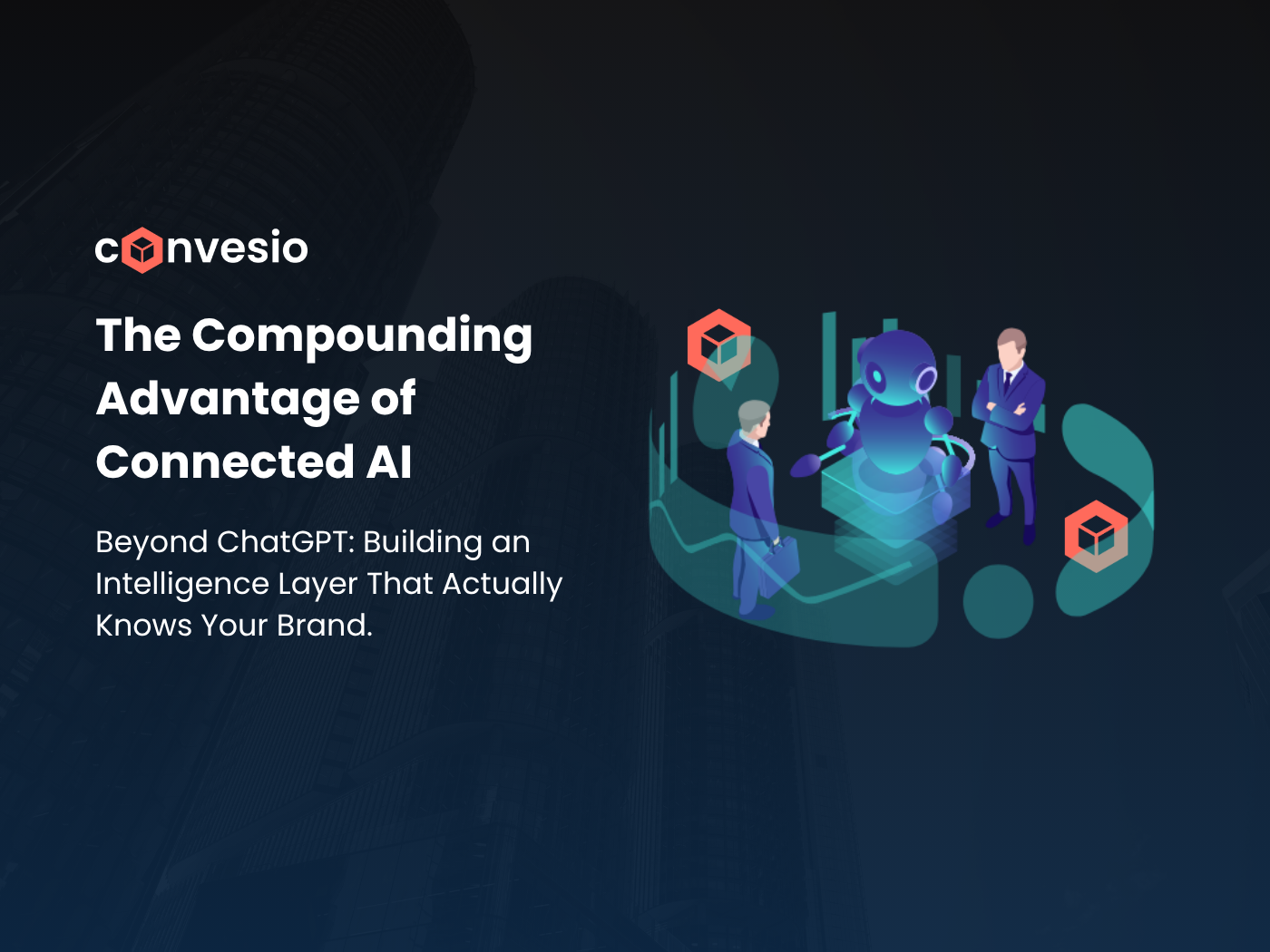
That ceiling is what connected AI breaks. For the last few months I’ve been working inside Claude Cowork, which plugs directly into the tools my work actually lives in Slack, Google Search Console, GA4, our website, ClickUp, Figma, and QuickBooks. The difference isn’t incremental. It’s a change in the kind of work AI can do with me, not just for me. Outputs start grounded in real Convesio data, in Convesio’s voice, against Convesio’s priorities. Which means less rework, more shipping, and the thing I didn’t expect, outputs that get better the more I use it.
That last part is the headline: context compounds. The longer I work this way, the bigger the gap gets between what I can do now and what I could do with a web-only chatbot.
Here are three real use cases that made me a believer.
Use case 1: Turning Slack threads into draft case studies
We’ve had a standing marketing goal for months: get more customer case studies published. And a standing problem: we didn’t have a structured way to mine the happy-customer moments that were already happening in our Slack channels every week.
With a generic AI, this task is impossible. You can’t paste six months of hosting-channel Slack history into a public chatbot for privacy, for security, and because no one has the time.
With Cowork, I asked it to look across our customer hosting channels for the last six months and pull out the wins worth writing up. It came back with four: each with the specific incident, the fix our team delivered, and the direct customer reaction in their own words. Things like “This is great, things seem nice and stable so far. Thank you.” from the engineering team after a performance upgrade, and “Awesome, thank you! Great service.” after a redirect fix.
Those aren’t magazine-cover quotes. But they’re real, they’re attributed, and they’re the starting point for a customer outreach conversation that is much warmer when you can say “we already know this made a difference for you.” Cowork then drafted the outreach emails to each of those three customers referencing the specific incident, the existing relationship, and the upcoming campaign each was planning so we could ask for a full testimonial with the door already open.
Four drafted case studies and three outreach emails, all grounded in real Slack history, in an afternoon. That’s the work of a week with a researcher and a copywriter. Because the raw material was already there, and connected AI could actually see it.
Use case 2: From raw GA4 export to a one-page CMO brief
Every marketer has a stack of unopened CSV exports. Easy Data that takes time to analyze with pivot tables and vlookups.
I asked Cowork to compare our last 90 days of GA4 data against the prior 90 days and tell me what was actually happening. Not just surface stats — the underlying story. It pulled the data, cleaned it (including catching a pile of Calendly booking URLs that were polluting the key-event counts), and came back with something I could hand to our CEO the same day:
- Key events up 25% on the cleaner data — site-wide conversion rate up 55% relative
- Homepage: over 200% more key events on fewer users. CR jumped from 0.36% to 1.06%
- /payment: converting at ~21% — roughly 6x the next-best non-confirmation page
- Knowledge base: down 44 key events, with traffic down nearly half — the AI-overviews story playing out in our own data
Then it connected those numbers to a content strategy: the information surfaces (KB, guides, case studies) are losing to AI-generated answers at the top of search, while our commercial-intent pages, calculators, pricing, /payment, vertical landing pages are converting harder than ever. The recommendation wasn’t “write more blog posts.” It was a ranked list of eight content formats (competitor comparison pages, vertical-specific compliance guides, original research) backed by our own behavior data.
I’ve been doing analytics reviews for more than a decade. That was a better 90-day readout than I would have produced in a week on my own — and it was built on our numbers, not a generic template.
Use case 3: A marketer’s read on our own Terms of Service
This one surprised me the most.
We had a task on the list to audit our public legal pages at convesio.com/legal — the sort of thing that tends to drift for a year or two before anyone looks at it seriously. I asked Cowork to read our live Terms of Service and give me a plain-language risk breakdown.
It didn’t just summarize. It pulled the actual clauses from the live page and ranked the risks:
- High: the blanket non-refund policy (a problem for EU/UK consumer-protection law), a unilateral “prices change immediately” clause, the reserves and setoff powers in the ConvesioPay section, and a thin HIPAA/BAA workflow given that we actively market HIPAA-compliant hosting and payments.
- Medium: auto-renewal language that may not meet specific US-state requirements, “commercially reasonable” security with no SOC 2 or ISO 27001 commitments called out, and a broad feedback-IP assignment clause that larger enterprise clients may push back on.
- Low: governing law, liability cap, indemnity direction, DMCA process, all in reasonable shape.
It was also careful to flag not legal advice and to recommend a payments/fintech lawyer for the ConvesioPay section specifically. That’s the right posture. I’m a marketer — I don’t need AI that pretends to be a lawyer. I need AI that reads the document, gives me a clear map of where to focus, and tells me when to call someone who is a lawyer.
That one-hour review surfaced four revisions worth taking to counsel and three that our team could handle internally. None of it required me to paste our legal pages into a chatbot.
The compounding advantage
None of these three use cases are possible with a web-only chatbot not because the AI isn’t capable, but because the context isn’t there. Generic AI reads the public internet. Connected AI reads the public internet and our Slack, our analytics, our brand voice skills, our live website, our content guidelines, our customer channels. The model is the same. The inputs are not.
And this is where the compounding kicks in. Every time I work through a problem in Cowork, the next problem gets easier. Customer quotes I surfaced for case studies fed into the content strategy conversation. The GA4 findings informed the legal review (because “we market HIPAA hosting” is a risk flag, and I knew exactly how much traffic those vertical pages were pulling). The brand-voice skills I’ve built up apply to every new piece of copy without being re-explained.
The moat is context. And every week I work this way, the moat gets deeper.
Generic AI is a fast intern who shows up every morning with no memory of yesterday. Connected AI is a teammate who already knows the account, the quarter’s priorities, and the customer’s name. I’m still the marketer. I still bring the judgment, the taste, and the accountability. But the multiplier is real and it’s the kind of advantage that gets bigger the longer you build on it, not smaller.
If you’re a marketer still copying and pasting into a browser tab, I’d encourage you to try a connected setup for a week. Not because the tools are magic, they aren’t but because the work you can do with real data, in your real voice, is a different category of work than generic AI produces.
And once you’ve seen it, it’s hard to go back to starting from zero.
Daryl Griffin is on the marketing team at Convesio. If you’re an agency or serious commerce operator exploring how connected AI could change your workflow, we’d love to hear what you’re working on — get in touch.